

Introduction
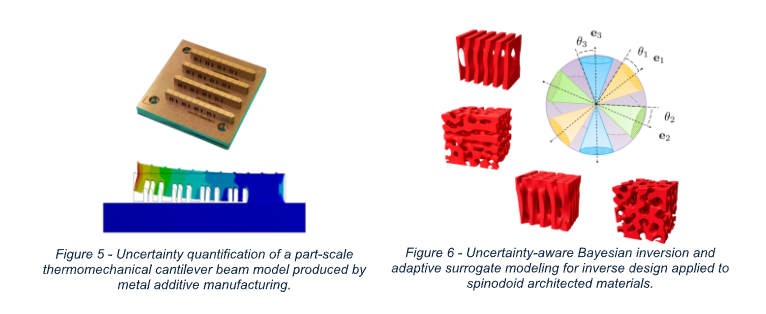
Engineering systems are affected by uncertainties arising from material properties, manufacturing processes, model assumptions, and experimental measurements. Reliable computational predictions therefore require methodologies capable of quantifying, propagating, and reducing uncertainty while maintaining computational efficiency. Research activities focus on uncertainty quantification, Bayesian inference, surrogate modeling, and inverse design methodologies for computational mechanics applications. Current developments address both manufacturing processes, with particular emphasis on additive manufacturing, and the design of advanced architected materials through data-driven and probabilistic approaches.
Goal
The main objective of this research activity is the development of efficient computational frameworks for uncertainty-aware modeling, simulation, and design. Current research investigates parameter calibration, Bayesian inversion, surrogate modeling, and uncertainty propagation techniques for complex engineering systems, with applications to additive manufacturing processes and their numerical simulation. A second research direction focuses on inverse design methodologies for architected materials, where probabilistic surrogate models and Bayesian approaches are employed to identify microstructural parameters associated with prescribed effective properties. Future developments will further explore the integration of uncertainty quantification, additive manufacturing technologies, and architected materials design within unified computational frameworks.
References
[1] Chiappetta, Mihaela, et al., “Sparse-grids uncertainty quantification of part-scale additive manufacturing processes”, International Journal of Mechanical Sciences, 2023.
[2] Chiappetta, Mihaela, et al. “Data‐informed uncertainty quantification for laser‐based powder bed fusion additive manufacturing”, International Journal for Numerical Methods in Engineering, 2024.
[3] Chiappetta, Mihaela, et al., “An Efficient Bayesian Framework for Inverse Problems via Optimization and Inversion: Surrogate Modeling, Parameter Inference, and Uncertainty Quantification”, arXiv preprintarXiv:2602.04537, 2026.