

Introduction
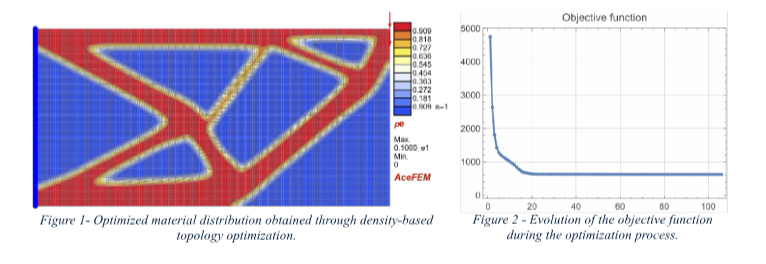
Topology optimization concerns the determination of the optimal material distribution within a prescribed
design domain subject to loading conditions, boundary conditions, and engineering constraints. The
methodology combines finite element analysis and mathematical optimization to support the design of
efficient structural configurations. Research activities have focused on density-based approaches, with
particular attention to the Solid Isotropic Material with Penalization (SIMP) method and optimization
algorithms based on Optimality Criteria (OC), Sequential Explicit Convex Approximation (SECA), and the
Method of Moving Asymptotes (MMA).
Goal
The main objective of this research activity is the development and analysis of computational methodologies
for structural topology optimization. Particular attention is devoted to the formulation of optimization
problems governed by mechanical constraints and to the numerical algorithms employed for their solution.
Current studies focus on density-based approaches and convex approximation techniques, with the aim of
improving the robustness and efficiency of optimization procedures.
Potential future developments include the integration of topology optimization with additive manufacturing
technologies and architected materials, where the interplay between geometry, material distribution, and
structural performance offers promising opportunities for computational design.
References
[1] M.P. Bendsøe and O. Sigmund, Topology Optimization: Theory, Methods and Applications, Springer,
2003.
[2] K. Svanberg, “The Method of Moving Asymptotes – A New Method for Structural Optimization”,
International Journal for Numerical Methods in Engineering, 1987.
[3] F. Auricchio, E. Carraturo, M. Montemurro et al., contributions on topology optimization and
computational design.