
DORIAN: modellazione Digitale a suppOrto del pRogetto di AmbIenti sicuri, sosteNibili e resilienti; GdL 6 – Biomateriali e Sostenibilità
Modellazione Digitale a suppOrto del pRogetto di AmbIenti sicuri, sosteNibili e resilienti – GdL 6 – Biomateriali e Sostenibilità
DORIAN
Michele Conti (Department of Civil Engineering and Architecture (DICAr), University of Pavia), Principal Investigator;
Franca Scocozza (DICAr), post-doc;
Gabriele Greco (DICAr), post-doc;
Ilenia Rita Renzulli (DICAr), phd-student.
€ 150.000
Italian Department of University Research (MUR)
—
2025-2028 (36 months)
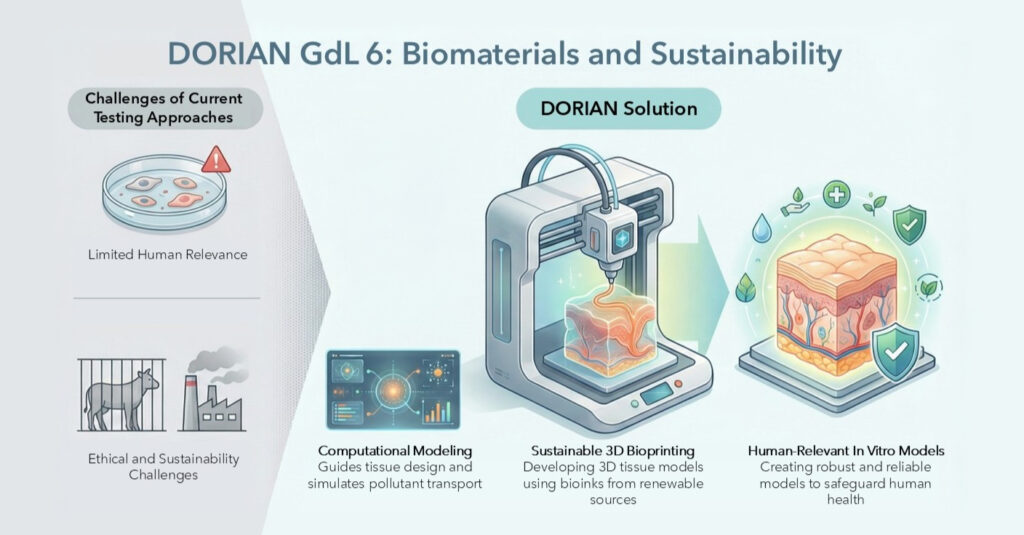
Traditional two-dimensional cultures and animal models often fail to accurately reproduce human-specific responses to environmental pollutants, while also raising ethical, economic and sustainability concerns.
Three-dimensional bioprinted tissue models, along with sustainable biofabrication methods, provide a promising way to study pollutant-tissue interactions in a controlled and reproducible environment.
The goal of this project is to develop sustainable, green bioprinted in vitro platforms for investigating the effects of environmental pollutants, such as microplastics, heavy metals and airborne particulate matter, on human tissues.
The research integrates the design of biodegradable bioinks derived from natural and renewable sources, including collagen-based biomaterials, with advanced 3D bioprinting techniques. Computational modeling supports a model-driven biofabrication strategy, guiding both the formulation of sustainable bioinks and the architectural design of 3D bioprinted tissue constructs, as well as the simulation of pollutant transport within the tissue microenvironment, while mechanical characterization is employed to assess their structural integrity, reliability, and reproducibility.
The developed approach aims to provide robust, scalable, and environmentally responsible in vitro models that can contribute to safer, more sustainable assessment strategies for human health and environmental exposure.