

Introduction
Predicting how cracks nucleate and propagate is a long-standing challenge in computational mechanics. Phase-field models tackle it by replacing the sharp crack with a smooth scalar field — the phase field — that regularizes it over a small length scale: complex crack paths (nucleation, branching, merging) emerge naturally on a fixed mesh, with no ad-hoc propagation criterion. Because the underlying equations involve high-order derivatives and require highly regular fields, they are a natural fit for Isogeometric Analysis (IGA), whose spline (NURBS / B-spline) bases offer arbitrary inter-element continuity together with an exact representation of the geometry.
Goal
The goal is to develop, analyze and validate high-order isogeometric phase-field formulations that predict cracks accurately at a lower computational cost. Leveraging IGA’s higher-continuity bases, we formulate and compare second- and fourth-order models (AT1 and AT2): for the same number of degrees of freedom, the fourth-order ones reach higher accuracy and a faster convergence of the fracture energy. The work covers the whole pipeline — consistent enforcement of crack irreversibility (as a symmetric linear complementarity problem or via a penalty method), an efficient staggered solver, and a systematic numerical–experimental validation against laboratory tests — and is being extended to dynamic fracture, fatigue, ductile failure, isogeometric shells, and adaptive refinement based on truncated hierarchical B-splines (THB).
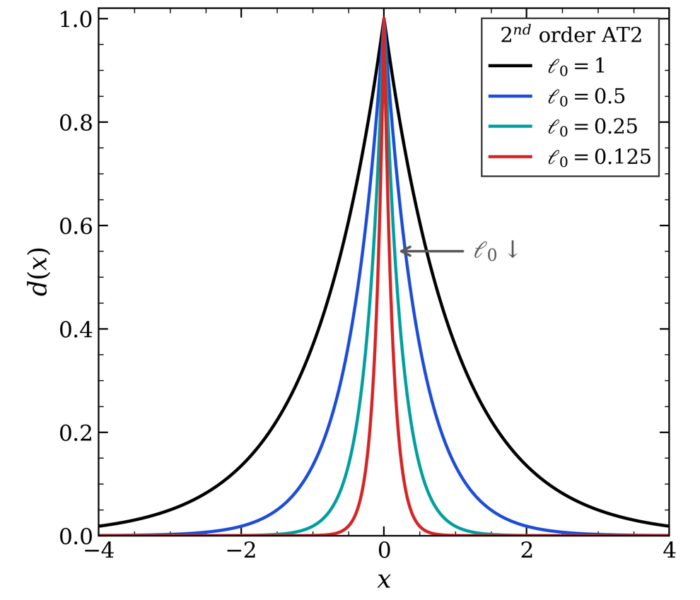
Fig. 1 (fig1_phase-field-profile.png) — The regularized phase-field profile d(x): as the length scale ℓ0 decreases, the smeared crack sharpens toward the true discontinuity.
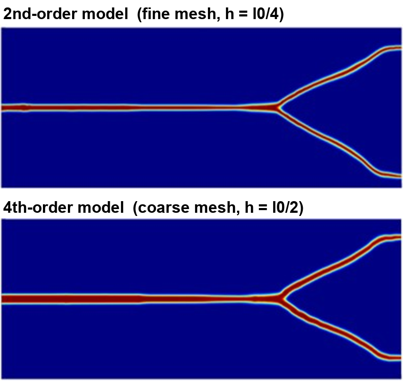
Fig. 2 (fig2_dynamic-branching.png) — Dynamic brittle fracture: the fourth-order model reproduces the same branching crack as the second-order one on a coarser mesh (CMAME 2025).

Fig. 3 (fig3_cpu-time-saving.png) — Efficiency payoff: for matching accuracy, the fourth-order model cuts CPU time by ~75–80% relative to the second-order one (CMAME 2026).
References
- Greco, A. Patton, M. Negri, A. Marengo, U. Perego, A. Reali, “Higher order phase-field modeling of brittle fracture via Isogeometric Analysis”, Engineering with Computers 40 (2024) 3541–3560.
- Greco, E. Maggiorelli, M. Negri, A. Patton, A. Reali, “AT1 fourth-order isogeometric phase-field modeling of brittle fracture”, Mathematical Models and Methods in Applied Sciences 35 (2025) 2741–2795.
- Greco, J. Kiendl, M. Negri, A. Patton, A. Reali, “Fourth-order isogeometric phase-field modeling of dynamic brittle fracture: numerical study and comparison with second-order models”, Computer Methods in Applied Mechanics and Engineering 449 (2025) 118513.
- M. Verhelst, L. Greco, A. Reali, “Adaptive isogeometric analysis of high-order phase-field fracture based on THB-splines”, Computer Methods in Applied Mechanics and Engineering 460 (2026) 119103.
- A. Francfort, J.-J. Marigo, “Revisiting brittle fracture as an energy minimization problem”, Journal of the Mechanics and Physics of Solids 46 (1998) 1319–1342.
- J. Borden, T. J. R. Hughes, C. M. Landis, C. V. Verhoosel, “A higher-order phase-field model for brittle fracture: Formulation and analysis within the isogeometric analysis framework”, Computer Methods in Applied Mechanics and Engineering 273 (2014) 100–118.