

Introduction
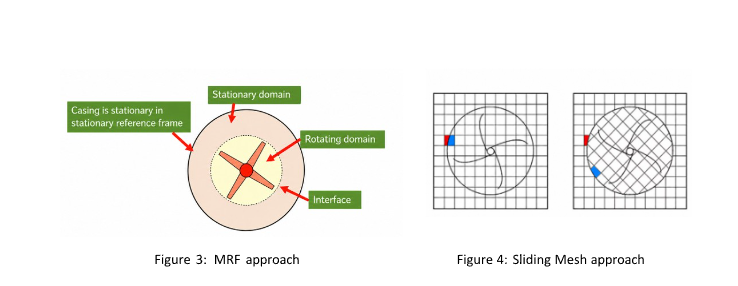
In contemporary turbomachinery engineering, Computational Fluid Dynamics (CFD) simulations represent the strategic standard for predict-ing full flow fields and validating hydraulic performance. The primary challenge lies in accurately modeling Rotor-Stator Interaction, where the momentum transfer between the impeller and the volute generates highly asymmetric pres-sure fields and complex, unsteady hydrodynamic phenomena [1]. To capture these effects, both commercial and open-source CFD codes implement a range of steady-state and transient modeling approaches. The Multiple Reference Frame (MRF) method is the conventional steady-state approximation, widely favored for its computational efficiency. In this configuration, frequently referred to as the “Frozen Rotor” approach, the fluid domains remain in a fixed relative position. Rather than resolving physical motion, rotation is simulated by integrating centrifugal and Coriolis accelera-tion source terms directly into the Reynolds-Averaged Navier-Stokes (RANS) equations [2]. However, this approach suffers from significant limitations. Because there is no actual relative motion between the mesh zones, the model is inherently incapable of capturing true transient phenomena. Furthermore, being a time-averaged formulation, it fails to resolve the instantaneous pressure fluctuations induced by blade rotation and exhibits a high sensitivity to the specific local angular orientation chosen between the rotor and stator [3]. To overcome these constraints, transitioning to models that incorporate physical
component rotation is essential. The Sliding Mesh (SM) method addresses these limitations by enabling the actual physical rotation of the rotor volumes relative to
the stator across a dynamic mesh interface. By physically displacing the rotor mesh nodes at each time step, this approach ensures strict temporal and spatial fidelity of
the fluid interactions. Consequently, unlike steady-state methods, the Sliding Mesh approach successfully maps the tem-poral evolution, shedding, and propagation of
vortices, as well as their direct interaction with the volute tongue [2, 3]. Conversely, these accuracy gains come at a cost: the Sliding Mesh approach demands
exceptionally high computational resources and requires highly robust, conservative interpolation algorithms to handle the moving interfaces seamlessly.
Goal
The primary objective of this work is to implement the previously seen strategies based on the rigorous mathematical framework of Domain Decompo-sition Methods within an open-source Finite Element Method software platform. Furthermore, this study aims to integrate Fluid-Structure Interaction (FSI) ca-pabilities, which are increasingly recognized as the necessary evolutionary step to overcome the limitations of conventional models, enabling the simultaneous evaluation of complex phenomena such as cavitation, vibrational fatigue, and non-linear mechanical deformations [1].
References
[1] Shah, S. R., Jain, S. V., Patel, R. N., & Lakhera, V. J. (2013). CFD for centrifugal
pumps: a review of the state-of-the-art.
[2] Dick, E., Vierendeels, J., Serbruyns, S., & Vande Voorde, J. (2001). Perfor-mance
prediction of centrifugal pumps with CFD-tools.
[3] Huang, S., Wei, Y., Guo, C., & Kang, W. (2019). Numerical simulation and
performance prediction of centrifugal pump’s full flow field based on
OpenFOAM.